Ideas & perspectives
Ideas from the factory floor, not the hype cycle.
Four arguments I keep returning to. Each one comes from a plant, a partner network or a scale-up where the technology was not the hard part.
- 01Perspective
Quality 4.0 Starts Before AI
Why most quality systems are not ready for intelligent automation.
I have read more deviation reports than I can count. Nearly all of them were written for the auditor. CAPAs close on paper. The data exists, but nobody structured it to be learned from, because learning was never the point.
Point a model at that and you get faster paperwork, not better quality. The work that has to come first is unglamorous: a deviation taxonomy people actually use, root causes that name a mechanism rather than a person, and a review cadence that ends in a change on the line.
Quality 4.0 is not a software category. It is what a quality system looks like once quality lives in frontline and leadership routines. Get there first, and AI has something worth reading.
- 02Perspective
AI Won't Fix a Broken Process
Why process maturity still matters in the age of AI.
I have watched organizations digitize a broken process and then wonder why the technology did not deliver. The process was the problem. The software just made the problem faster and more expensive.
If a process runs three different ways on three shifts, there is no process to automate. There are three. Standard work, ownership and stable data come before any tool, whether that tool is a workflow engine or a language model.
Your process is the prompt. When the process is vague, the output is vague, and it arrives with confidence.
- 03Perspective
From Automation to Autonomous Operations
The Operational Excellence layer behind autonomous manufacturing.
Autonomous operations get described as a technology destination. In practice the gap between an automated line and an autonomous one is operational, not technical: decision rules, escalation thresholds, data ownership and the discipline to keep them current.
The ladder is the same everywhere I have worked. A Lean foundation, then a digital process, then AI-assisted decisions, then autonomy for the narrow set of decisions where the rules are clear and the data is trusted.
Skipping a rung does not save time. It moves the failure downstream, where it costs more.
- 04Perspective
Optimize Before You Automate
A practical operating principle for digital transformation.
I have been saying this for ten years and I still lose the argument under budget pressure. Understand the work. Remove the waste. Stabilize the process. Build the right data. Then automate.
The reason it matters is arithmetic. Automating a wasteful process locks the waste in and adds a maintenance cost on top. Optimizing first shrinks the scope of what needs automating, and often removes the need entirely.
In regulated manufacturing this sequence also protects you: a stable, well-understood process is easier to validate, easier to explain to an inspector, and easier to hand to a model.
Books
Process improvement and AI are one discipline, not two.
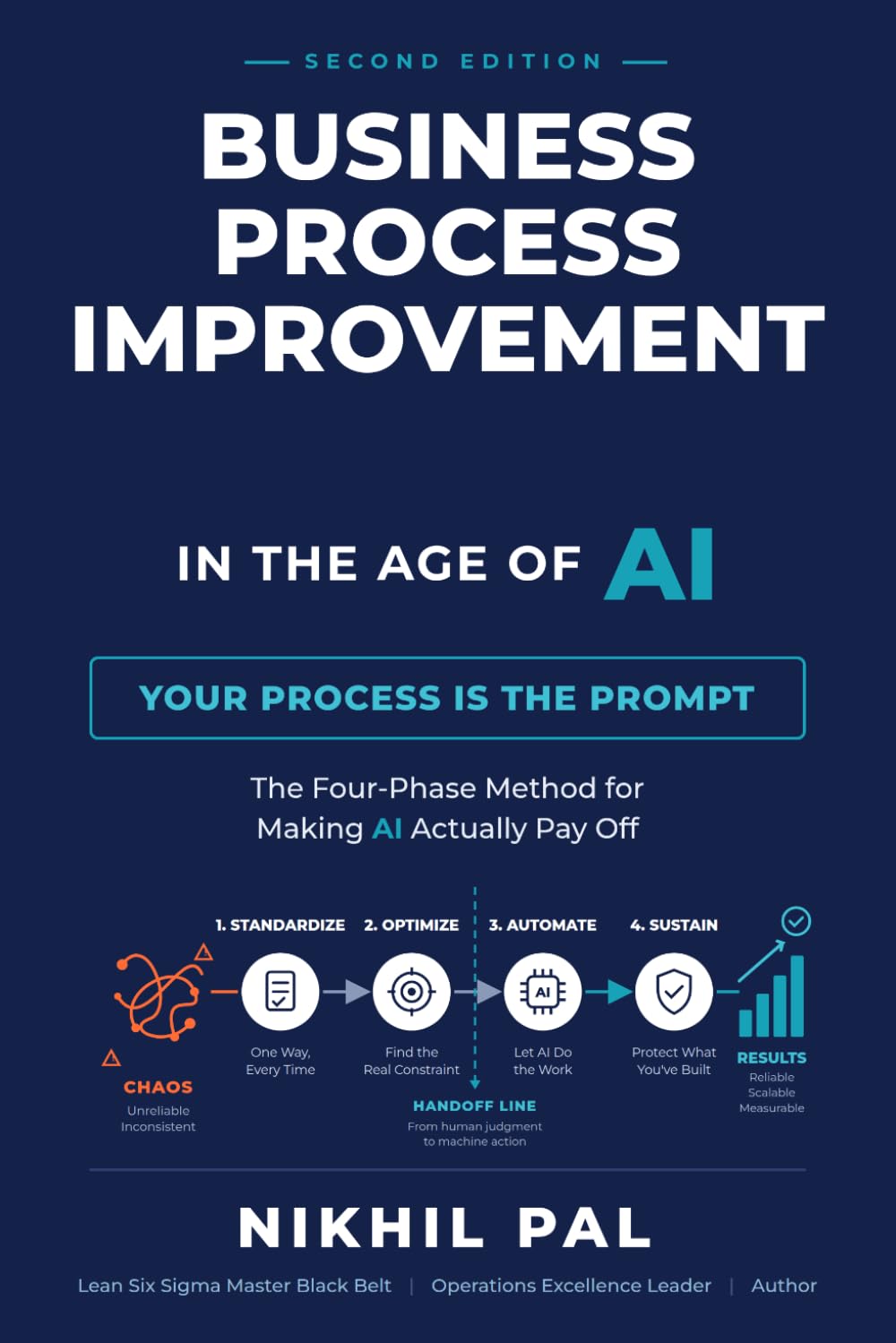
Second edition, available now
Business Process Improvement in the Age of AI
View on AmazonI wrote this book because I kept seeing the same split. Lean people treating AI as hype. AI people treating Lean as a museum piece. Both are wrong, and the plants that win will be run by people fluent in both.
It is built around a four-stage sequence I have used in four countries: Standardize, Optimize, Automate, Sustain. And one working rule that has not let me down yet: your process is the prompt.
- Nikhil Pal
AI-Powered Lean Six Sigma
Transforming Smart Manufacturing for the Next Decade
Coming soonComing soon
AI-Powered Lean Six Sigma
Transforming Smart Manufacturing for the Next Decade
The same argument, written for Black Belts. How to put AI and analytics inside DMAIC, daily management and problem solving without losing the rigor that makes the method work.
Articles
Published in
- Process Excellence Network
- IndustryWeek
- TechBullion
On digital transformation, Lean Six Sigma, AI in manufacturing, smart manufacturing, change management and Industry 4.0.
Research
PhD candidate, Management Sciences and Engineering
University of Waterloo, Canada
Research on data-driven operational excellence and circular supply chains in biopharma manufacturing. Working paper: From Circular Economy to Circular Performance: A Governance-Based Framework for Regulated Manufacturing.
Reviewer, International Journal of Lean Six Sigma. Jury member, World OPEX Awards 2026.